Future Opportunities
Published in The Charlotte Business Journal as a guest opinion article, June 11, 2026
Urban designer and architect Terry Shook previously shared his perspective relating to the Charlotte City Council’s decision regarding the proposed toll lanes on Interstate 77. In this second installment, Shook, along with Larry Zinser, a partner with Shook Kelley, explains the future opportunities before Charlotte.
Change rattles people. Forgoing $600 million in funding for a road project — any road project — certainly falls in this category. The realities of this decision, however, are not as clear-cut as the proponents of the original toll road plan allege, nor is the abandonment of this plan setting us on a dire path toward a civic rift between citizens and business interests.
A civic meltdown is not on the table if we come together for the common good.
I presented in my first installment a path that leverages this moment for a better future for Charlotte, and for the region. Here is why I am optimistic we will achieve a better outcome.
An expanded view of toll roads
“Is there any reason for a long-distance freight hauler or a family SUV full of kids and dogs to pass through the heart of Charlotte on the way to somewhere else?”
I have heard countless variations upon this question over the past few months from all kinds of people. This question, though, has not been one in the public conversation, nor has the role of I-485 regarding regional and interstate traffic.
Parallel to the I-77 toll lane plans, the N.C. Turnpike Authority (under the auspices of the North Carolina Department of Transportation) is actively exploring the expansion of toll lanes along I-485. This, I believe, is important to the conversation. I-485 has sufficient right of way to absorb on-grade toll lanes in a more cost-efficient manner — not unlike the northern segment of I-77.
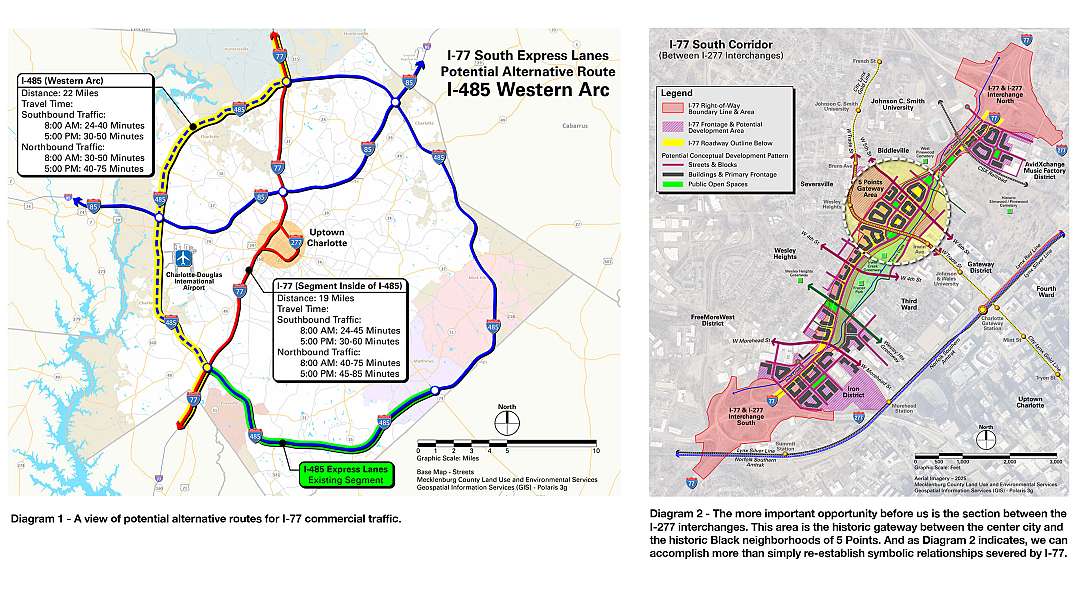
It is not unreasonable to assume the originally proposed elevated lanes on I-77 would cost four to five times more than those on the ground. Moreover, as Image 1 depicts, the western leg of I-485 is only 13% longer than I-77 through center city.
Re-routing much of I-77 traffic, toll or otherwise, to I-485 is sound on multiple fronts. The western leg of it passes by the airport (an ever-expanding multi-modal facility for freight) and puts truck traffic closer to Gaston County, which is increasingly becoming the region’s home for industry and distribution.
Bypassing the urban core was why I-485 was built, or at least that was a core part of the argument. Hewing to its original purpose seems only rational as we consider both the region’s and the city’s transportation future. (see Diagram 1)
Level setting transportation issues
Understanding the actual future transportation demands upon the center city section of I-77 is a crucial next step. It is likely that within the existing rights of way, an urban solution can be created that balances traffic demand with community opportunity.
For example, lane widths for interstates outside of cities, where the design speed is 70 miles per hour or more, are 12 feet. Often, in true urban conditions where, for many reasons, design and posted speed limits are 50 miles per hour, the width can and often is reduced to 10 feet. The nominal number of existing lanes between the I-277 interchanges with I-77 is eight; their width is 12 feet. So, under this approach, adding two lanes, be they toll or otherwise, is reasonable.
For those who may balk at a 50 miles per hour speed limit, consider these two facts: First, studies have shown that the most “throughput” — the number of cars traversing any given section of road — is in the 50 miles per hour range. And second, this speed is noticeably safer than 70 miles per hour. More lanes within a more efficient and safer design should be everyone’s goal.
The other reality to acknowledge is that I-77 traffic flow at peak commuter hours is determined by bottlenecks. Within the center city, the biggest one is the I-277 interchange, where I-77 intersects I-277, and where Morehead Street, Wilkinson Boulevard, Freedom Drive and West Boulevard all slam into it. At 3:30 p.m. on any given workday, traffic comes to a halt on I-77 in this area.
Recognizing that these bottlenecks exist and that other NCDOT funds may be available to address it is encouraging. However, these tactical responses need to take place within an overall, and likely phased, strategic approach to reconnecting neighborhoods, and in city building.
A real estate development approach to I-77
A number of citizens and groups have proposed transportation solutions merged with development opportunities. The more important opportunity before us is the section between the I-277 interchanges. This area is the historic gateway between the center city and the historic Black neighborhoods of 5 Points. And as Diagram 2 indicates, we can accomplish more than simply re-establish symbolic relationships severed by I-77. (see Diagram 2)
A new housing-centric neighborhood, including a reenvisioning of the underdeveloped and aging Tarleton Hills project of Inlivian, could rise upon and on both sides of the now capped freeway. As in all great neighborhoods, both rental and private ownership housing would be included for people of varying family types and incomes.
Some homes would be for the chronically poor — but even more for the “working poor.” All kinds of people fall into the category of “workforce” — those who represent the backbone of our greater community. Police, fire, many categories of hospital personnel, school teachers, food service workers, city and county employees, and many others find themselves caught between a job serving our community and yet not making enough to adequately house themselves within the city. Often, they seek housing in surrounding towns and counties where either the rent is cheaper or they can afford a starter home.
This, though, is a Hobson’s choice: pay less for housing, and much more for transportation.
Such choices fuel a vicious cycle, one that only adds to the number of cars on our highways and roads at peak hours. And the time spent in travel from home to work can rob the commuter of two or more hours per day.
The stress, though, can be measured in more than time and increasingly crowded roads. Brian Goldstone, in his book There Is No Place for Us: Working and Homeless in America, chronicles the lives of five working families as they face the spiraling cost and unavailability of housing in Atlanta. All of them make the downward transition from working poor to homeless.
All these issues, and the path I suggest, are grounded in economics. Solutions that work will be complex; involve thoughtful and transparent processes from many quarters; and take time to craft the right social and funding mechanisms.
Criticism from all manner of naysayers will come from many quarters. But I have faith that we can do this. This is Charlotte, the home of boosterism, and the people and place that has historically defied conventional wisdom to achieve seemingly impossible things. This is our time, and our opportunity, to continue building this great city of the future.